
The Great Migration hero

The goal of the Great Migration Study Project is to create comprehensive biographical and genealogical accounts of all immigrants to New England from 1620 to 1640, from the arrival of the Mayflower to the decline of immigration resulting from the beginning of the English Civil War. The project was conceived by Robert Charles Anderson and was proposed to the New England Historic Genealogical Society early in 1988. Anderson and the society quickly reached an agreement, and the project officially began on 15 November 1988.
There had been several comprehensive surveys of immigrants to New England published in the last third of the 19th century or the first third of the 20th century: Savage’s Genealogical Dictionary of the First Settlers of New England (1860–1862); Austin’s Genealogical Dictionary of Rhode Island (1887); Pope’s Pioneers of Massachusetts (1900); and Noyes, Libby, and Davis’s Genealogical Dictionary of Maine and New Hampshire (1928–1939). Although these compendia are important resources and will continue to be valuable for many years, they have been superseded in many instances by genealogical research published more recently. That is where the Great Migration Study Project comes in....
For each immigrant to New England, whether an unattached individual or a family group, the approach of the Great Migration Study Project is to survey the most important compiled accounts of the immigrant, whether in the survey sources noted above, in separate monographs, or in the periodical literature. These accounts are then checked against a wide range of original source material, including vital records, church records, deeds, probate records, court records, and a variety of other types of documents. Finally, all of this material is examined and cross-correlated, with special attention to discrepancies between sources, whether primary or secondary. The ultimate goal is a comprehensive account of the individual which synthesizes what is known at the date of publication and will serve as a solid foundation for future research.
The entire time period of the Great Migration to New England has been divided into smaller, more manageable chronological chunks, within which range of years the sketches are published in alphabetic order. The three volumes in the First Series cover the immigrants who arrived in the years from 1620 through 1633. The Great Migration Begins: Immigrants to New England, 1620–1633, published in 1995 as a three-volume set, contains more than nine hundred sketches. (Although this covers two-thirds of the time period under investigation, it only contains about one-sixth of the total number of immigrants. Beginning in 1634 and running until the end of that decade, the annual rate of migration became much higher.)
The Second Series of seven individual volumes covers the immigrants who arrived in the years 1634 and 1635 and bears the title The Great Migration: Immigrants to New England, 1634–1635. The books in this series are Volume I: A–B (1999); Volume II: C–F (2001); Volume III: G–H (2003); Volume IV: I–L (2005); Volume V: M–P (2007); Volume VI: R–S (2009); and Volume VII: T–Y (2011). (For the first two of these seven volumes, Anderson was joined as author by George F. Sanborn Jr. and Melinde Lutz Sanborn.)
In 2004 a portion of the First Series was revisited by extracting about two hundred sketches of those who had resided in Plymouth Colony in the earliest years. Their sketches were updated to take into account the wide range of new research in this area since 1995. They were also revised, correcting those errors that had been discovered in the original research and upgrading the sketches with some material not included in the original version. The resulting volume is The Pilgrim Migration: Immigrants to Plymouth Colony, 1620–1633. In 2012 a similar update was undertaken for those immigrants who had arrived in 1629 and 1630 under the aegis of the Massachusetts Bay Company. That volume is called The Winthrop Fleet: Massachusetts Bay Company Immigrants to New England, 1629-1630.
In 1990 Robert Charles Anderson commenced publication of the quarterly Great Migration Newsletter, which ran for twenty-five volumes, ceasing publication at the end of 2016. Each issue of the Newsletter includes as its centerpiece a lengthy "Focus" article which examines closely one of the early New England towns or an important set of early records. The Newsletter also includes shorter articles, editorial commentary, and a "Recent Literature" section which surveys current monographic and periodical literature relating to the Great Migration and its immigrants. (All 100 issues of the Great Migration Newsletter, with a comprehensive index, are available for purchase as a single volume.)
In 2018 American Ancestors published Anderson's seminal narrative work, Puritan Pedigrees: The Deep Roots of the Great Migration to New England, in which he explores the “why” of the Great Migration and reveals the many genealogical, social, intellectual, and religious connections among these first migrants. This was followed by The Mayflower Migration: Immigrants to Plymouth, 1620, published in 2020 for the 400th anniversary of the sailing of the Mayflower. In addition to Anderson's insightful essay on the Leiden and London "contingents" of passengers, The Mayflower Migration provides newly discovered material for the sixty passengers covered in 2004’s The Pilgrim Migration, including brief biographies of twenty-eight for whom we have info about their lives before they sailed.
The next major undertaking for the project was released in 2015 and has become the most important genealogical and historical source ever published for New England. The Great Migration Directory: Immigrants to New England, 1620-1640—A Concise Compendium lists all known immigrants by head of household with their English origin, date of migration, principal residences in New England, and best available bibliographic citation. (An expanded and updated Second Edition of the Directory was published in 2025 to celebrate its 10th anniversary. Eighty-nine of the immigrants in the total of 5,700 are newly discovered. Sadly, it is also Bob's final book for American Ancestors.)
The next step was to divide the remaining fifty percent or so of arrivals into two segments, the first of which will cover the years 1636, 1637, and 1638. The first volume in this Third Series, The Great Migration: Immigrants to New England, 1636–1638, Volume I: A–Be, with Ian Watson as author, was published in 2024. American Ancestors will publish Volume II of the Third Series in 2026. It will be the first volume authored by our new Great Migration Study Project Director, Nathan W. Murphy, MA, AG, FASG, and will cover letters Bi–Bu. (The Third Series will likely extend to eleven or twelve volumes.)
While migration ended in 1640 with the calling of the Short Parliament in the spring of that year, it did not end abruptly, bringing perhaps half as many new arrivals in 1640 as had come over in each of the previous six years. In 1641 and thereafter, immigration continued, but at a much reduced pace. The Fourth Series, The Great Migration: Immigrants to New England, 1639–1640, will in due course complete the compilation of sketches of all known immigrants to New England. (Note that with this division of the last five years of the migration, the Fourth Series will require fewer volumes to complete than the Third Series.)
American Ancestors is pleased to announce that Nathan W. Murphy, MA, AG, FASG, is the new director of the Great Migration Study Project. Nathan worked closely with Robert Charles Anderson, FASG, from July 2022 until Bob’s passing in February 2025 and helped put the finishing touches on the new edition of The Great Migration Directory: Immigrants to New England, 1620–1640. Nathan was first introduced to the Great Migration Study Project as an undergraduate at Brigham Young University. In the genealogy computer lab at BYU, the Great Migration books occupied a shelf of their own, with empty space reserved for forthcoming volumes. A professor once told him that it would take “more than one lifetime” to complete the series. And now Nathan is part of that legacy!
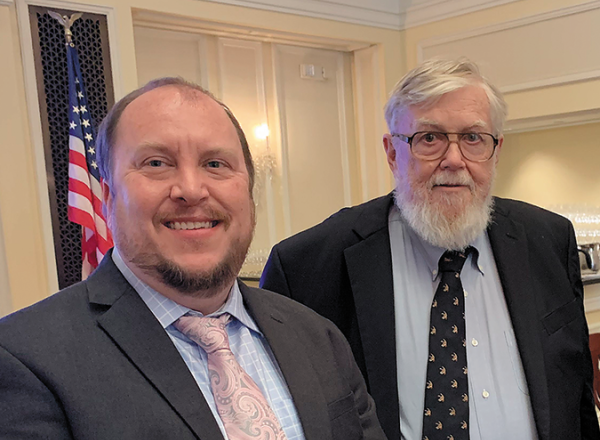
Robert Charles Anderson was Director of the Great Migration Study Project for more than 36 years. He held degrees from Harvard, the California Institute of Technology, and the University of Massachusetts Amherst. Bob was first educated as a biochemist and served in the United States Army in electronics intelligence. He began devoting his energies to genealogical research in 1972, creating a body of work that would enrich the lives of countless researchers, historians, and descendants of the 20,000 English immigrants who came to New England between 1620 and 1640.


Eighty-nine immigrants have been added to this 2nd edition of the most important genealogical and historical source ever published for Ne

This sixteenth book in the Great Migration Study Project opens with an essay on what led up to the sailing of the Mayflower and

This popular book from the Great Migration series is now available in paperback.

In early 1629 the Massachusetts Bay Company received a royal charter that allowed the Company to carry on the work, begun earlier in the
Analyze records and make sound genealogical conclusions using the same method applied by Robert Charles Anderson for the Great Migration
Under the leadership of Robert Charles Anderson, the Great Migration Study Project aims to compile authoritative genealogical and biograp
Under the leadership of Robert Charles Anderson, the Great Migration Study Project aims to compile authoritative genealogical and biograp
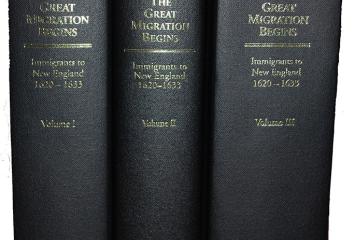
Already a classic, this three-volume set contains the most accurate, up-to-date information on over 900 New England families!
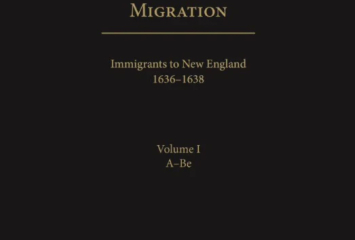
This first volume in the third series of the Great Migration Study Project contains new research to uncover the details of 129 immigrants
Already a classic, The Great Migration Begins reflects immense scholarly resourcefulness and is a tremendous source for anyone r
Author: Robert Charles Anderson
Published: 1999
Already a classic, this three-volume set contains the most accurate, up-to-date information on over 900 New England families!
The Great Migration Begins Immigrants to New England 1620-1633 (3 Volume Set)
The years 1634 and 1635 were watershed years for New England immigration. The influx of immigrants represents twenty percent or more of the entire Great Migration period. Like The Great Migation Begins, these books continue to identify and document early New England families.
Author: Robert Charles Anderson, George F. Sanborn, Melinde Lutz Sanborn
The Great Migration: Immigrants to New England 1634-1635, Volume I, A–B
The Great Migration: Immigrants to New England 1634-1635, Volume II, C-F
Author: Robert Charles Anderson
The Great Migration: Immigrants to New England 1634-1635, Volume III, G-H
The Great Migration: Immigrants to New England 1634-1635, Volume IV, I-L
The Great Migration: Immigrants to New England 1634-1635, Volume V, M-P
The Great Migration: Immigrants to New England 1634-1635, Volume VI, R-S
The Great Migration: Immigrants to New England 1634-1635, Volume VII, T-Y
This first volume in the third series of the Great Migration Study Project contains new research to uncover the details of 129 immigrants with surnames beginning with A to Be who came to New England between 1636 and 1638 and appear in the Great Migration Directory.
The Great Migration: Immigrants to New England, 1636-1638 Volume 1, A-Be